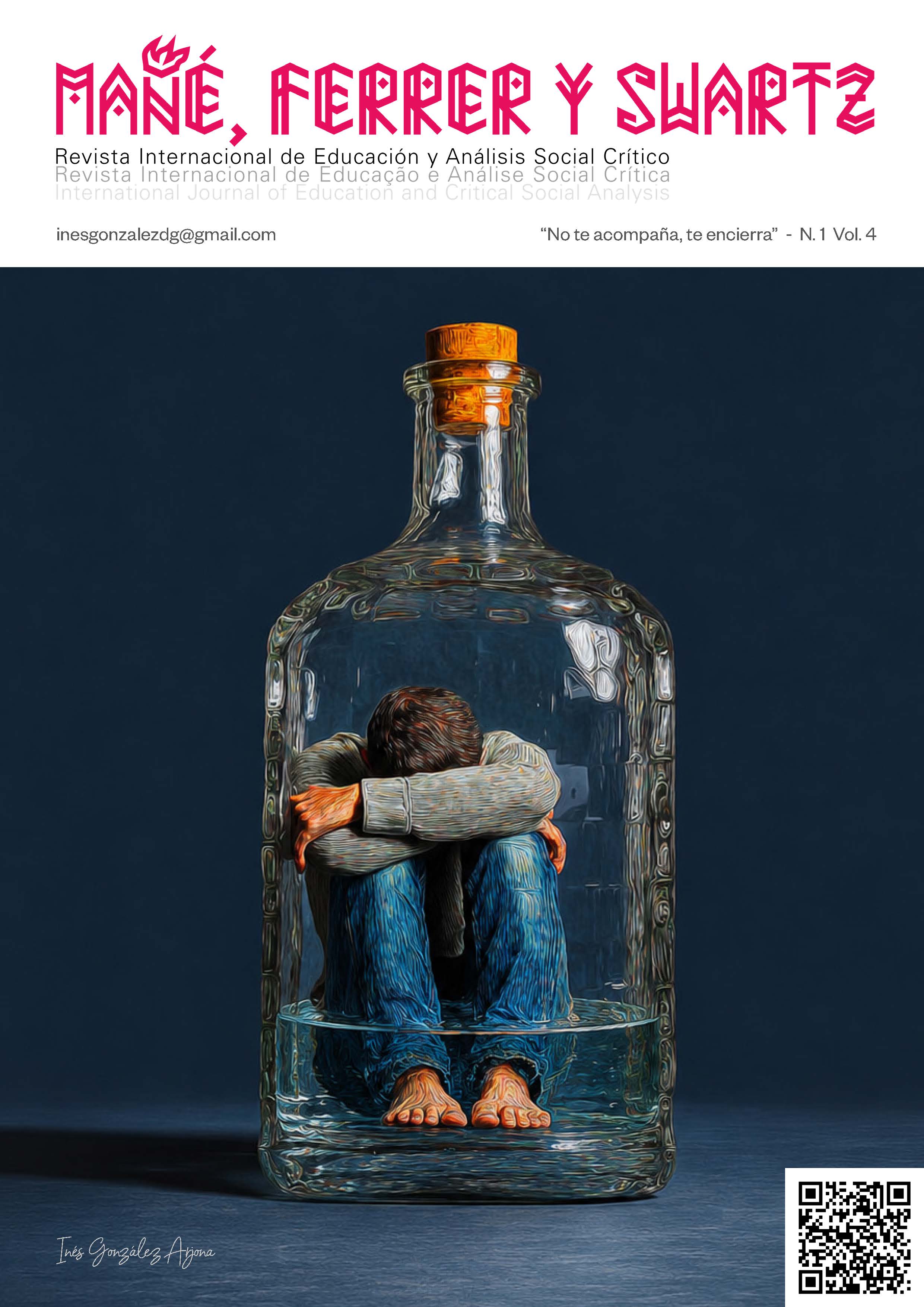
Montessori: Pedagogical innovation, fascist affinity, and the commercialization of education 493 426
DOI:
https://doi.org/10.51896/easc.v4i1.1244Keywords:
Educational capitalism, didactics, fascism, history of education, pedagogical research, Montessori method, Montessori, educational theoryAbstract
Even today, for some, Maria Montessori remains one of the most influential figures in education, and her methodology continues to be applied in tens of thousands of schools worldwide, more than a century after its invention. However, this article presents a narrative review of the darker and lesser-known aspects of the method and its creator, with the aim of initiating a critical debate. It analyzes how her methodology has been commercialized to this day, as well as how the interests behind this process may have altered our perception of the Italian educator's pedagogical proposals and her own history, minimizing questionable aspects such as her relationship with Mussolini's regime. Investigating and revealing this dark side of Montessori's life and work is essential for applying her ideas critically and responsibly in the classroom, without being influenced by interests unrelated to education. According to our research, the Montessori Method appears to have become practically a commercial "brand" for the sale of materials, the creation of centers, and the offering of private training courses. Regarding the method itself, while it represented a significant advance for its time, it was not based on a rigorous scientific methodology that would justify some of its more questionable principles and elements for classroom application, such as the lack of cooperative work and the development of creativity before the age of six. As for the author, among other aspects, it has been shown that Maria Montessori collaborated with Mussolini's fascist regime between 1922 and 1933, and the regime's great interest in the methodology, coupled with Montessori's silence on the matter, is curious.
References
Asociación Montessori Española. (2026). Asociación Montessori Española. https://asociacionmontessori.net/
Asociación Montessori Málaga. (2026). Nuestra asociación. Asociación Montessori Málaga. https://asociacionmontessori-malaga.org/
Barnes, H. G. (12 de febrero de 2020). No es Montessori todo lo que reluce: España enloquece con el método educativo de moda. El Confidencial. https://www.elconfidencial.com/espana/2020-02-12/metodo-montessori-educacion-espana_2450892/
Bernabé, E. E. (2016). María Montessori y su método educativo ¿Es posible su aplicación en el aula de Educación Secundaria y Superior? En M. G. Rios, M. B. Hernández y E. E. Bernabé (coords.), Mujeres en las letras: pioneras del arte, el ensayismo y la educación (pp. 1135-1148). Región de Murcia. https://www.carm.es/edu/pub/20_2016/libropdf/MUJERES_DE_LETRAS_html.pdf
Bone, J. (2017). María Montessori as domestic goddess: iconic early childhood educator and material girl. Gender and Education, 40(1), 673-678. https://doi.org/10.1080/09540253.2017.1396293
Britton, L., y Molina, P. P. (2000). Jugar y aprender: el método Montessori: guía de actividades educativas desde los 2 a los 6 años. Paidós.
Carrera, L. I. y D’Ottavio, A. E. (2016). La lucha social multisecular femenina por acceder a la práctica médica. Contribuciones a las Ciencias Sociales, Marzo de 2016, s. p. https://www.eumed.net/rev/cccss/2016/01/lucha.html
Chavarría, M. C. (2012). ¿Está Montessori obsoleta hoy?: a la búsqueda del Montessori posible. Revista Rupturas, 2(1), 58-117. https://dialnet.unirioja.es/servlet/articulo?codigo=4888197
Creswell, J.W. y Poth, C. N. (2018). Qualitative Inquiry and Research Desing. Choosing among five approaches. SAGE.
De Stefano, C. (2020). El niño es el maestro. Vida de María Montessori. Lumen.
Delgado, J. R., Vivanco, C. I., Ayala, M. A. y Cuenca, L. (2021). Una experiencia didáctica a través del ambiente montessori [sic] en la enseñanza de la matemática. Boletín Redipe, 10(11), 198-215, https://doi.org/10.36260/rbr.v10i11.1527
Demangeon, A., Claudel-Valentin, S., Aubry, A., & Tazouti, Y. (2023). A meta-analysis of the effects of Montessori education on five fields of development and learning in preschool and school-age children. Contemporary Educational Psychology, 73, 102182. https://doi.org/10.1016/J.CEDPSYCH.2023.102182
Denzin, N. y Lincoln, Y. (1994). Handbook of Qualitative Research. Thousand Oaks.
Edwards, C. P. (2006). Montessori education and its scientific basis. Journal of Applied Developmental Psychology, 27, 183-187. https://doi.org/10.1016/j.appdev.2005.12.012
Fallace, T. (2023). The racism of Maria Montessori. Journal of Curriculum Studies, 55(5), 619-631. https://doi.org/10.1016/j.appdev.2005.12.012
Foschi, R. (2020). Maria Montessori. Ediciones Octaedro.
Fundación Argentina María Montessori. (2026). Historia y misión. Fundación Argentina María Montessori. https://www.fundacionmontessori.org/somos-famm/historia-y-valores/
García, G. (11 de mayo de 2025). “Después de 4 años en una escuela Montessori, me vi obligada a poner al día a mi hija con clases particulares”: la crítica de una madre al famoso método de aprendizaje. Infobae. https://tinyurl.com/2y377px8
García, L. (2018). La utilización de fuentes de datos secundarios. En F. Requena Santos y L. Ayuso Sánchez (Eds.), Estrategias de investigación en las ciencias sociales (pp. 139-172). Tirant Lo Blanch.
Gentaz, E. & Richard, S. (2022). The Behavioral Effects of Montessori Pedagogy on Children’s Psychological Development and School Learning. Children, 9(2), 133. https://doi.org/10.3390/children9020133
Hawthorne, B. (2019). Dr. Montessori's Racism. Montessori Life, 31,61. https://www.proquest.com/docview/2460562919?sourcetype=Magazines
Hermida, A. L. (6 de septiembre de 2021). 10 preguntas y respuestas sobre el método Montessori. International Montessori Institute. https://montessorispace.com/blog/10-preguntas-y-respuestas-sobre-el-metodo-montessori/
Infinite Women. (2026). Maria Tecla Artemisia Montessori. Infinite Women. https://www.infinite-women.com/women/maria-tecla-artemisia-montessori/
Intel Market Research. (2026). Montessori Toys Market Growth Analysis, Dynamics, Key Players and Innovations, Outlook and Forecast 2026-2034. Intel Market Research. https://www.intelmarketresearch.com/montessori-toys-market-37156
International Montessori Institute. (2026). Cursos destacados. International Montessori Institute. https://montessorispace.com/
Kramer, R. (2019). María Montessori. Biografía de una innovadora de la pedagogía. SM.
L’Ecuyer, C. (2023). Montessori: origen y razones de las críticas a una de las pedagogas más controvertidas de la historia. Revista Española de Pedagogía, 81(285), 251-270. https://revistas.unir.net/index.php/rep/article/view/64/451
Leenders, H. (2017). A special meaning of “health”. Towards a theory-immanent explanation for the use of the Montessori Pedagogy in fascist Italy (1926-1934). Annali di Storia dell’Educazione, 25, 197-207. https://www.researchgate.net/publication/327246407_A_special_meaning_of_health_Towards_a_theory-immanent_explanation_for_the_use_of_the_Montessori_Pedagogy_in_fascist_Italy_1926-1934
Lillard, A. S. (2013). Playful learning and Montessori education. Namta Journal, 38(2), 137-174. https://eric.ed.gov/?id=EJ1077161
Lizabe, G., Binia, I. y Vasquez, M. G. (2015). Historia de la medicina a través de sus mujeres. Sanadoras y médicas desde la antigüedad hasta el Siglo XX. Editorial Dunken. https://bdigital.uncu.edu.ar/objetos_digitales/14165/lizabe-biniayvasquez-historiadelasmujeresenlamedicina.pdf
Marazzi, G. (2000). Montessori e Mussolini: la collaborazione e la rottura. Dimensioni e problemi della ricerca storica, 1, 177-195. https://mega.nz/file/mB5miDKS#jXZ_kr-5rT8mlNyjNgirqT7nJm6G1KcbPQVvMQ3AOUU
Marshall, C. (2017). Montessori education: a review of the evidence base. npj Science Learn, 2, 1-9. https://doi.org/10.1038/s41539-017-0012-7
Martínez, M. J. y Marín, J. P. (2022). Origen, difusión y comercialización del material Montessori en el primer tercio del siglo XX. Revista d’Història de l’Educació, 40(1), 131-159. https://doi.org/10.2436/20.3009.01.287
Ministerio de Educación y Formación Profesional. (2022). Real Decreto 157/2022, de 1 de marzo, por el que se establecen la ordenación y las enseñanzas mínimas de la Educación Primaria. Boletín Oficial del Estado, 52, 1-109. https://www.boe.es/buscar/act.php?id=BOE-A-2022-3296
Montessori, M. (2002). Método de la Pedagogía Científica. Dover. [Trabajo original publicado en 1912]. https://dspace.itsjapon.edu.ec/jspui/bitstream/123456789/3976/1/El%20Metodo%20Montessori.pdf
Montessori Canela Internacional. (2026). Formación humana y accesible. Nuestros cursos de Pedagogía Montessori para profesores. Montessori Canela Internacional. https://www.montessoricanela.es/
Montessori para todos. (2026a). Caja de sonidos Montessori Minúscula + Mayúscula. Montessori para todos. https://montessoriparatodos.es/caja-de-sonidos-montessori-minuscula-mayuscula.html
Montessori para todos. (2026b). Mueble con 12 bastidores Montessori. Montessori para todos. https://montessoriparatodos.es/mueble-con-12-bastidores-montessori.html
Montessori School of Silicon Valley. (22 de junio de 2018). Intrinsic vs Extrinsic Rewards. Montessori School of Silicon Valley. https://msosv.com/2018/06/22/intrinsic-vs-extrinsic-rewards/
Morssink-Santing, V. E., van der Zee, S., Klaver, L. T., de Brouwer, J., & Sins, P. H. M. (2024). The long-term effect of alternative education on self-regulated learning: A comparison between Montessori, Dalton, and traditional education. Studies in Educational Evaluation, 83. https://doi.org/10.1016/j.stueduc.2024.101380
Palacios, A., Barreras, A. y Pascual, V. (29 de marzo de 2026). Mil años antes del ‘skincare’: la herencia borrada de Trótula de Salerno. The Conversation. https://doi.org/10.64628/AAO.dyraxx7gh
Palumbo, M. y Calzolari, E. (2005). Maria Dalle Donne M.D. two century after her appointment as director of the School of Midwifery in Bologna. Med Secoli, 17(1), 205-219. https://pubmed.ncbi.nlm.nih.gov/16285091/
Pérez, C. (2002). Sobre la metodología cualitativa. Revista Española de Salud Pública, 76(5), 373-380. http://scielo.isciii.es/scielo.php?script=sci_arttext&pid=S1135-57272002000500001&lng=es&tlng=es
Quarfood, C. (2022). The Montessori Movement in Interwar Europe: New Perspectives. Palgrave Macmillan.
Sanchidrián, M. C. (2021). El método Montessori en la educación infantil española: luces y sombras. Historia de la educación, 39(1), 313-335. https://doi.org/10.14201/hedu202039313335
School of Feminism. (2022). María Montessori, la primera mujer médica y educadora italiana. School of Feminism. https://www.schooloffeminism.org/post/mar%C3%ADa-montessori-la-primera-mujer-m%C3%A9dica-y-educadora-italiana
Segurbaby. (2026). Mobiliario Montessori. Segurbaby. https://segurbaby.com/39198-mobiliario-montessori
Seichter, S. (2024). Der lange Schatten Maria Montessoris. Der Traum vom perfekten Kind. Mit E-Book inside Beltz Verlagsgruppe.
Seldin, T. (2026). Which should I choose, AMS or AMI? The Montessori Foundation. https://www.montessori.org/which-should-i-choose-ams-or-ami/
Downloads
Published
Issue
Section
Categories
License

This work is licensed under a Creative Commons Attribution-NonCommercial 4.0 International License.